Me@Walmart: The Standardization
Role:
Staff Designer
Platform:
Mobile/Web
Year:
2023
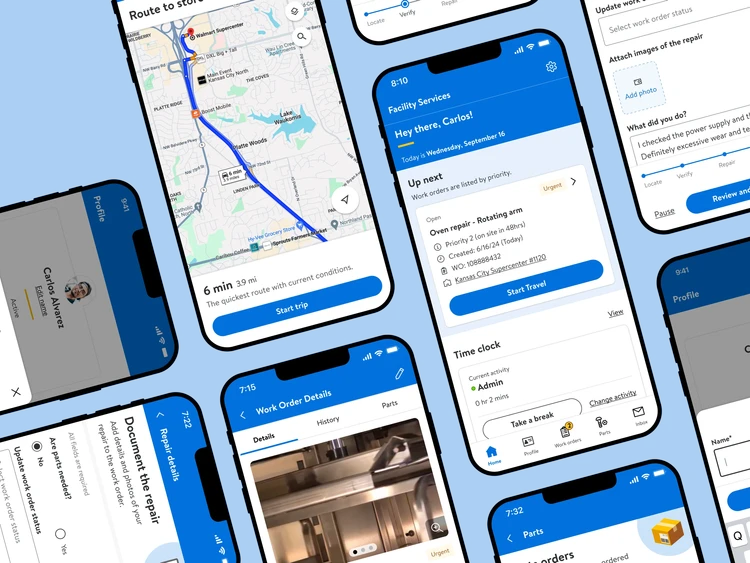
Walmart's frontline associates were on Me@Walmart, an app that had absorbed the functions of 90+ legacy work tools into one surface. The consolidation worked. The navigation didn't.
1.35 million associates were active monthly. Average session: 128 minutes. Across 450+ screens, every product team had improvised its own page structure, its own back-button behavior, its own notification placement. Sarah, an associate quoted in our research, said it took eight back-taps to switch between tools. Eric, a team lead, said he missed messages because notifications weren't visible.
I led the audit that diagnosed the drift, designed the page-level taxonomy that fixed it, and shipped the standardization across all of Me@ Core in three months.
01 • FRAMING
This wasn't a navigation problem. It was a taxonomy problem.
The brief read like a navigation problem: "improve wayfinding, fix the back button, surface notifications." I treated it as a taxonomy problem.
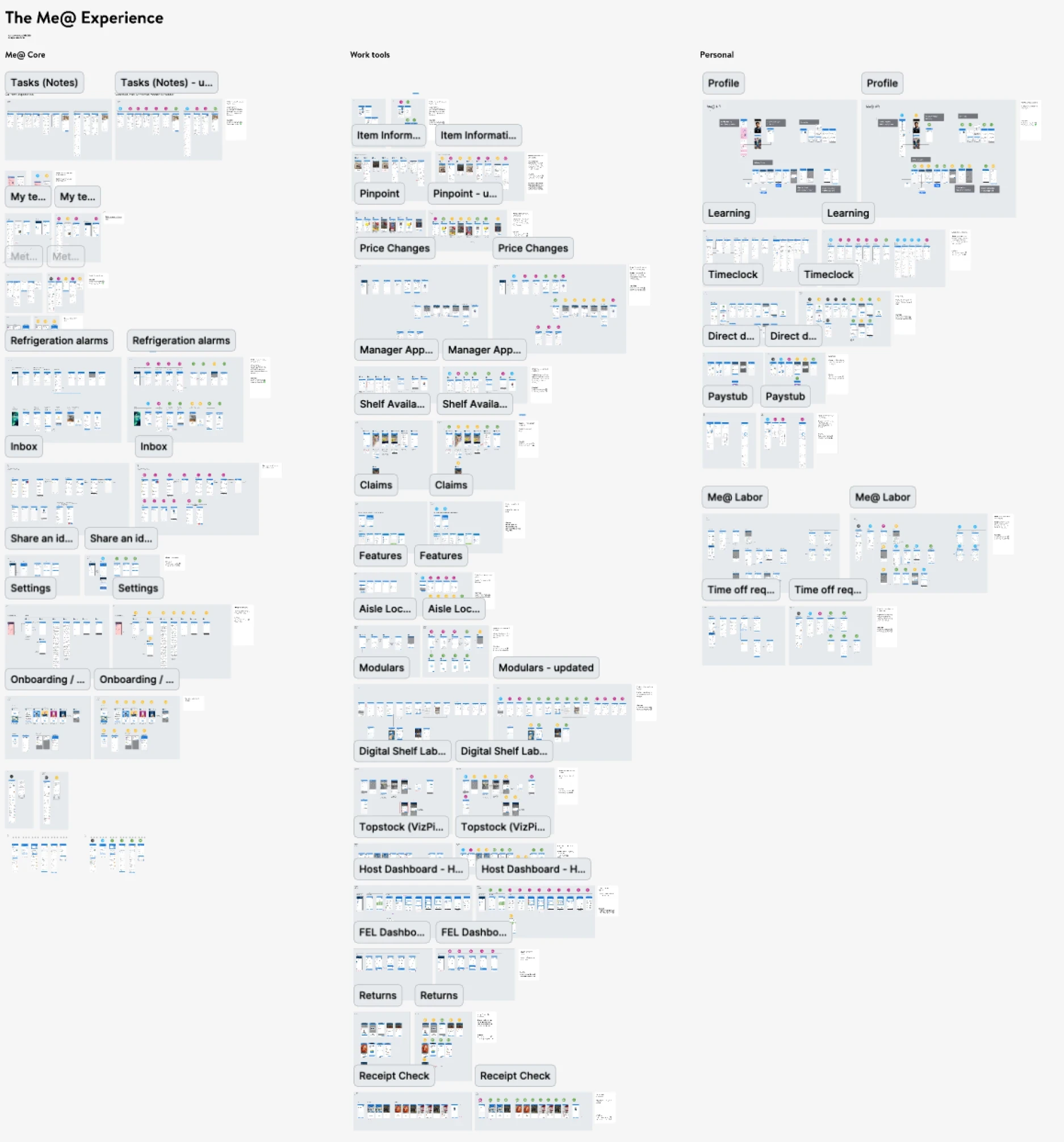
Wayfinding doesn't break because individual screens are wrong. It breaks because the model of where you are doesn't match how the system is structured. With 450+ screens across three feature areas (Me@ Core, Work tools, Personal) and no shared idea of what counts as a "home," a "list," or a "detail" page, every team was working from a different map. Associates were paying the cost of that incoherence.
The reframe: define four page levels, then make every screen in the app conform. The taxonomy is the constraint that produces consistency.
02 • STRATEGIC DECISION
Four calls that standardized 450 screens.
Four page levels, not three or five. After auditing the 450+ screens, the patterns clustered into four roles: a personal snapshot (home), a hub overview (landing), a grouped list of related things (list), and a single-focus detail view (detail). Three levels collapsed list and detail too much; five levels created an ambiguous middle. Trade-off: some surfaces don't fit cleanly into one of the four. Gain: every product team can answer "where does this screen belong?" in seconds. Principle: a taxonomy is only useful if the categories are small enough to memorize.
Notifications and messages move to the top header. The default was a bottom-tab pattern with notifications buried in a tab. Eric and other team leads were missing critical messages because the visual hierarchy didn't surface them. I moved notifications and messages to the top header, persistent across every page level. Trade-off: breaks the familiar bottom-nav convention; top header gets visually busier. Gain: associates stop missing the messages that matter. Principle: the convention is worth breaking when the cost of following it shows up in user research quotes.
Standardize the structure, not the styling. Each product team kept its own visual treatment within the page-level templates. The taxonomy specified what each level does, not what it looks like. Trade-off: less brand uniformity across the app. Gain: teams could ship without renegotiating their visual identity, which is what kept the rollout to three months instead of nine. Principle: when standardizing at scale, mandate the skeleton and let teams own the skin.
Audit before designing. 450 screens analyzed and a full sitemap of the existing architecture built before any new design was drawn. Trade-off: slower start; the team wanted recommendations before the audit was done. Gain: the recommendations were grounded in observed patterns instead of assumed ones. Principle: design recommendations are only as good as the diagnostic that preceded them.
03 • THE PAGE TAXONOMY
Four levels, every screen, one model.
The most distinctive artifact in this project is the four-level page taxonomy. Every screen in Me@ Core, across three feature areas and 450+ surfaces, now belongs to one of four levels:
L0 Home. A snapshot of the associate's day, with access to time-sensitive actions. One per associate.
L1 Landing. A high-level overview of a hub, with the ability to drill down. One per feature area.
L2 List. A grouped list of related things, organized by mental model. Many per hub.
L3 Details. A single focus with its relevant attributes. The terminal node.
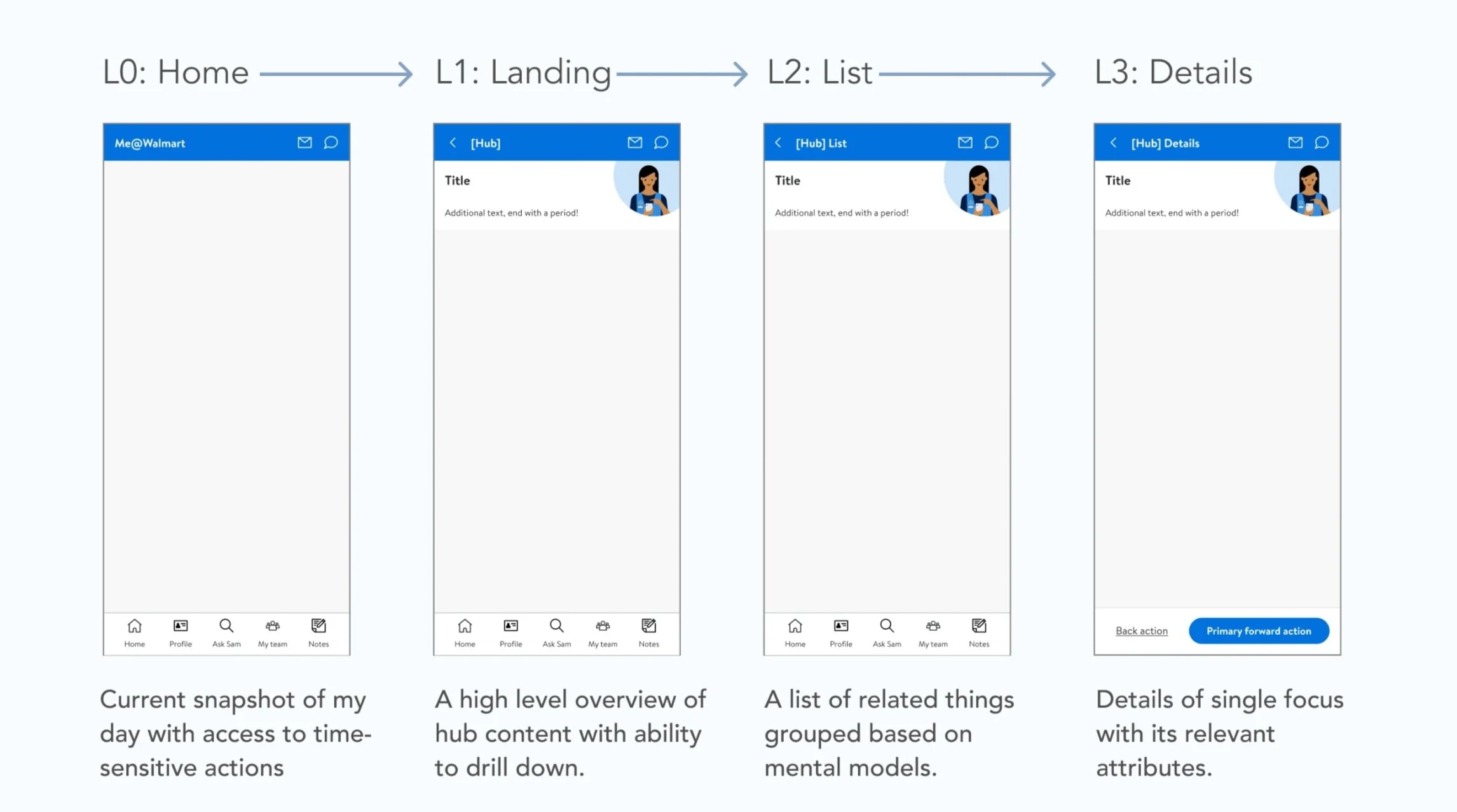
The model is hierarchical: Home → Landing → List → Details. Each level has a defined role, a template, and a navigation convention. A new product team building a feature in Me@Walmart now picks a starting level and inherits the structure. They don't reinvent the page model.
The taxonomy is also a contract. When MyAssistant and Universal Search teams started building newer paradigms a few months later, they had a defined baseline to negotiate with. They could argue against the taxonomy (and they did, in places) but they couldn't ignore it. The standardization made the next wave of work legible even where it didn't fit cleanly.
04 • THE PUSHBACK
What the next paradigm argued back.
The hardest conversations weren't with the product teams adopting the taxonomy. They were with the new teams working on MyAssistant and Universal Search.
Their argument: a page-based taxonomy is too rigid for conversational and search-first interfaces. A chat surface isn't a "landing" or a "list." A universal search result isn't a "detail." Forcing those experiences into the four-level model would either compromise them or strand them outside the system entirely.
The conversation didn't resolve into a clean answer. What it produced was the recognition that the page taxonomy was the right model for the structured surfaces it covered, and that the new paradigms needed a parallel framework rather than a forced fit into the existing one. The standardization shipped across all of Me@ Core in three months. The conversation about how it interacts with conversational and search-first surfaces is still active.
That's the honest version. The taxonomy didn't solve everything; it made the next set of problems legible.
05 • CROSS-FUNCTIONAL LEADERSHIP
Standardizing a surface I didn't own.
I led a small core design team through the audit, taxonomy design, and rollout, while operating cross-functionally with the product teams that owned each feature area.
Owned the end-to-end audit of 450+ screens across Me@ Core, Work tools, and Personal
Built the sitemap of the existing architecture that grounded every recommendation
Designed the four-level page taxonomy (L0 Home, L1 Landing, L2 List, L3 Details) and the templates for each
Drove the rollout across all of Me@ Core in three months, partnering with the product teams that owned each feature area
Made the call to move notifications and messages to the top header against the bottom-nav convention
Presented the taxonomy and adoption plan to leadership and partner teams across Me@Walmart, including the MyAssistant and Universal Search teams that built alongside it
06 • OUTCOMES
1.35M associates.
Audience and scale
1.35M monthly active associates using Me@Walmart
128 minutes average monthly engagement per associate
450+ screens audited across three feature areas
90+ legacy work apps consolidated into the surface this work standardized
What shipped
Full adoption across all of Me@ Core within 3 months of the taxonomy landing
Notifications moved to the top header reduced missed-message complaints from associates and team leads
Four-level page taxonomy (L0-L3) became the baseline that subsequent work, including MyAssistant and Universal Search, negotiated with
Beyond the project. The taxonomy outlived the standardization push that produced it. New paradigms argued against it in places, but they argued to it, which is the outcome that matters for design system work. The next generation of work treats the four-level model as a reference rather than an obstacle.
07 • REFLECTIONS
Taxonomies have a shelf life.
Page-level taxonomies have a shelf life. The model I shipped was the right one for the surfaces it covered, but the surface itself is changing faster than the taxonomy can absorb. Universal search and conversational interfaces aren't pages; they're different paradigms that need different frameworks.
If I had the work to do again, I'd build the page taxonomy and start drafting its successor at the same time. Treating standardization as the end state, rather than as the stable layer that the next standardization replaces, is how design systems calcify. The right move at staff level is to ship the current model and document why it will eventually need to evolve.
The deeper lesson is about what audit work is for. Audits feel like maintenance, but the good ones produce frameworks that outlast the project. The 450 screens I reviewed are mostly redesigned by now. The four-level taxonomy is still in use. That's the artifact that mattered
PROCESS APPENDIX
The audit analyzed Me@Walmart from the perspective of key associate roles, mapping every screen in Me@ Core, Work tools, and Personal. The sitemap surfaced two structural problems:
Wayfinding was inconsistent: similar tasks had different navigation patterns across mini-features.
Critical surfaces (notifications, messages) were buried in tab structures that hid them at the moments associates needed them most.
The competitive analysis compared Me@Walmart's patterns against external benchmarks (consumer apps with similar information density) and internal best practices from other Walmart product surfaces. The four-level model was the consolidation of that pattern analysis.